Showing posts with label Motor Racing. Show all posts

Monday, April 15, 2013

Put a puncture in painful Pirelli

Motor Racing

Formula One Management are destroying their sport with a tyre from Pirelli that looks more determined to spew rubber than hold itself together.

I wish I were exaggerating but I'm not. If the measure of skill behind the sport is 'who is the quickest driver' then the tyre needs to allow this vision to be realised, not the show we saw instead in China.

Current degradation, particularly on the softer compounds, is making drivers hold back when they should be letting loose. Because this is motor racing after all, isn't it?

Not a single driver in the Chinese Grand Prix raced for eight laps on the soft compound. When your medium, or standard, compound is being used for an average of 20 laps then you know the race is becoming borderline 'artificial.'

Lewis Hamilton was very vocal in the lead up to the race saying that he had never had tyres behave this way before. Qualifying soon attested to his worries, with his teammate Nico Rosberg losing five seconds over as many laps in a horror stint.

Hamilton's former team principal, McLaren's Martin Whitmarsh, said that "it's quite excruciating trying to save tyres. It's painful... and however bad it is for me, it must be a lot worse if you have to drive like that."

If I'm feeling heated about it from the perspective of a viewer, I can't begin to imagine the frustration of teams.

In saying this, I certainly don't want a return to the early 2000's where the superior car trounced all and driver ability had a slightly lesser impact. Schumacher's Ferrari F2004 was the most dominant machine I've seen since Senna and Prost's infamous McLaren MP4/4.

Though the racing was flat out in both years, the gulf between the front and mid pack was incredibly wide. Let's never see that again. We should be thankful that today as many as five teams look more than capable of taking home a race win.

Instead, I want a balance. Believe it or not, we can live in a world where tyre degradation, car performance and driver ability can have an equal impact on an F1 championship. We just haven't found it yet.

Fernando Alonso celebrates winning the 2013 Chinese Grand Prix

Pit stops can make or break a race, but there is no need for three of them. I'm all for degradation having a slight impact on strategy, but as for defining a race (or even a championship)? It's gone too far.

Pirelli, to their credit, are only providing what 'challenge' has been given to them by FOM. They were asked to create a compound that fell away quickly and that would constantly asks questions of team strategy more than driver ability.

Much of the hate they have received should be directed towards the management responsible for the orders. It's not becoming a good look for the Italian manufacturers, as they are forced to swat off criticism race after race.

It almost brings out a desire to see another tyre war between suppliers, a-la Bridgestone/Michellin, to keep teams on edge and monitor each other to improve tyre performance.

A solution could be to set some form of quality control for tyre manufacturers, where a predefined rubber compound could be put in place. It could then have slight alterations made to it as long as they fall with certain boundaries.

The arguments for the poorer quality tyre are that it lends itself to more exciting racing and strategies, but the sport comes down to the driver. After piecing a car together, maintaining it and testing it, only one member of a team gets to run it around the track.

Why can't we have a tyre that respects that?

Saturday, March 23, 2013

Three incredible racetracks that are missed on the Formula One calendar

Motorsport

Perhaps it's the recent rise of the street circuit or the lack of undulation on modern circuits, but I can't shake the feeling that viewers of 2013 Formula One are being robbed of some of racing's most exquisite tracks.

It's made me reflect on those circuits we've had stripped from the calendar and how the commercial nature of Formula One is influencing decisions in track design that tarnish 'quality' racing.

A common thread I've noticed between these tracks I've listed is that they are not as thrilling for track side viewing as they come across on the television screen.

Yet as I say that, tracks such as Spa still have a place on the calendar despite giving little viewing opportunities because of its design and location. It hardly then seems a fitting excuse.

The true reason for the rapid rise of the street circuit is that it seems to be the perfect match that meets both the racing and the commercial needs of organisers. You can put spectators virtually on top of the action at almost any corner of the track and the urban location gives arguably greater economical benefits to the host country and therefore the sport in general.

Though is that coming at the cost of more traditional racing style? Hermann Tilke's redesign of Hockenheim remains as one of the greatest catastrophes of modern racing, in my book. It destroyed the essence of that track. What was once a track with a technical final sector and a sweeping, forest filled middle sector is now a slow mess and has no 'identity.'

Here are three exceptional tracks that would give the championship a much needed lift in race quality.

#1: Magny-Cours

There are several things the world needs more of: Peace, prosperity and fast chicanes. France's greatest piece of tarmac outside of Circuit La Sarthe, Magny-Cours, delivers the latter in spades.

The 'Imola' chicane's inside kerb (turn 12) is blind upon entry and will certainly punish any driver that misses the mark. It's fast and a pleasure to watch as drivers snake their way through before scrambling for the brakes into turn 14.

The closest thing we have to the Estoril turn, with its big test of when to put the foot down out of the corner, is Spoon at Suzuka. The turn very long. It feeds beautifully into a fast back straight with a great overtaking opportunity at the end hairpin.

Of the tracks listed, it's the most stop/start in nature. However the elements in between the slower sections complement this well. France still has good driver participation in Formula One and the fans would support a return to the country for sure. Magny-Cours would also remain the better option instead of circuit Paul Ricard if a French track were to make a return.

#2: Red Bull (A1) Ring

Redesigned by Tilke as a safety measure in 1996, and still kept its basic structure with a shortened length. The whole track has wonderful flow to it and plenty of undulation to keep the drivers on edge. The drive up to turn 2 presents a great overtaking opportunity, at the peak of the track, for anyone who got a nice drive out of the opening turn.

The track is simplicity defined. There's no complex elements to the track and it is capped off nicely with two speedy right hand turns a-la Monza, with a bit more kerb use.

And what about that scenery? Literally no other racetrack in the world can combine such wonderful views and good racing so well. Just check out the view when coming out of turn one.

#3: Istanbul Park

The latest victim of the Ecclestone axe. Removed from the Formula One calendar after 2011 when organisers failed to negotiate a new contract. A real pity, because for mine this was the second best track on the calendar following Spa.

Like the Belgian masterpiece, this Turkish track is home to one of the best turns in world racing. The four apex turn 8 is a monster and a great lesson in nailing a perfect racing line to set yourself up for the perfect exit. Not an easy thing when clipping four inside corners at full speed. Great to behold.

The back straight is as good as they come and is an excellent overtaking opportunity in the both its second half of the straight and the following turn.

Also rivals Melbourne for the best opening turn on the calendar. Action guaranteed with the dipping left hand bend. Would love to see a return for the track, not just for its fun style of racing, but just so I can admire that pit complex once more.

Sunday, July 29, 2012

An innovation for a stale Formula?

Motorsport

If someone had told me that this year's Formula One World Championship would see seven winners from as many races, then calling them crazy probably wouldn't have been enough.

It's been a breath of fresh air following one of the most one-sided championships since Schumacher's Ferrari days, where Sebastian Vettel romped home to the title with several rounds to spare.

Regulations on exhaust placement to cut down on aerodynamic advantages has arguably had the biggest influence on leveling out this year's competition. It's helped Williams find their first victory in eight years, in partnership with engine supplier Renault once more just like their glory days in 90's.

It's brought Lotus F1 into the fight for the minor placings in the constructors championship and almost brought Sauber their first victory as an independent team.

The lack of off-throttle blown diffusers has cut back Red Bull's distinct edge over the rest of the field, and as viewers we must be better off for it. Or are we?

While innovations in bodywork and aerodynamics come to the fore every season, tyre quality has taken a step in the opposite direction.

Pirelli took over the helm of tyre supplier from Bridgestone at the beginning of the 2011 season, and all the pre-season talk last year was about the rapid degradation of the new rubber. Rightfully so.

Last year's blistering debacle at Spa was a testament to how unprepared the supplier was to cope with Formula One standards of wear and tear.

Last year's Pirelli's spent much of 2011 in the headlines for wrong reasons. Source: f1.co.uk

Now into their second season, Pirelli have improved the longevity of their prime tyre considerably. There has been much less talk about the rubber this year than 2011, but the issue is still there for people to see.

They feel like a shadow of the giant Bridgestone that preceded them, in terms of consistency and quality.

Now, for sure, this hasn't impeded on the quality of the racing this year. In fact, it has given it a unique flavour.

Just look at Mark Webber's prime tyre move on the outside of Fernando Alonso at Silverstone to win the race, as the Spaniard's soft compound gave up on him. The gap between compound durability has never been larger.

It does raise the question though of whether we should be celebrating more exciting racing as a result of poorer standards of parts - in this case the tyres.

It seems to conflict with the ethos of Formula One, that is it being the pinnacle of engineering and mechanical innovation.

F1 Chief Executive Bernie Ecclestone has employed little tricks like the Drag Reduction System to mask the issues Pirelli have had.

It's been creating tacky, fake overtaking scenarios and not allowing the racing to be the direct result of the drivers' abilities.

At the halfway point in this season I can say this is easily the most thrilling season I've witnessed since 2008, where the championship came down to the final corner at Brazil to give Lewis Hamilton his title. But I may end up looking back on 2012's season wondering why I enjoyed it.

Should a sport forget its roots in new ideas and forward thinking for the sake of a bit of entertainment?

I've never felt so split down the middle looking at this fine sport.

Sunday, March 27, 2011

Vettel takes opening round win

Motorsport

Current World Champion, Sebastian Vettel, has won the opening race of the Formula One season, ahead of Lewis Hamilton and podium newcomer Vitaly Petrov, to win his third straight race.

The Red Bull driver led the race from start to finish, following a blistering pole-setting time yesterday, and marks a perfect start to his title defence.

McLaren's Lewis Hamilton finished the race as he started, in second, despite breaking the undertray of his car on lap 33. The 2008 World Champion finished clear of Renault's Vitaly Petrov, who displaced local hope Mark Webber for a spot on the podium.

The young Russian held off a late charge from Fernando Alonso, in a repeat of their stand-off in Abu Dhabi last year, to claim his first top three finish.

But there was no wiping the smile off the World Champ, who found himself on an Australian podium for the first time, let alone on top of it.

Vettel was challenged in the first fifteen laps by Hamilton, when his tyres looked to be wearing quicker than the McLaren behind him.

"The first thing was to try to hold the gap. But you see the cliff... the degradation... [meant] I couldn't do more laps," the World Champ said.

Things looked a touch sketchy for Vettel as he was forced to pit several laps before Hamilton, but he managed to hold a consistent and comfortable lead throughout the remainder of the race, as his tyres held strong.

"I think we have to make some compliments to Pirelli" he added, in reference to the recent criticisms of the new rubber for 2011, "after the tests we were scared."

It is the first win of the Australian Grand Prix for Renault since 2006, when Alonso won the race after winning the championship in the previous year, as did Vettel today.


RACE REPORT:

A relatively quiet Melbourne race was seen, devoid of the carnage seen in some of the previous editions, including a clean start on the notorious first turn.

Notable movers in the first lap included Petrov bolting up two places to fourth, Formula One debutant Paul Di Resta piloting his Force India up to tenth after starting four spots further back as well as Felipe Massa making a surprise move up to fifth on the first corner.

Massa soon found himself under attack from Jenson Button. In the first use of the DRS (Drag Reduction System) moveable rear wing during a race, Button was unable to make the pass on the Ferrari at turn 1.

Things got worse for Button on lap 11, when an attempted inside pass on Massa at turn 12 resulted in him being forced to cut the turn. When both Ferrari's pitted before him, leaving him unable to let them through, stewards were given no option but to give Button a drive through penalty.

With the decision coming before his first pit stop for tyres, the penalty virtually ended Button's hopes of winning a third straight Australian Grand Prix. But the Briton had it lucky compared to many other teams coming to Melbourne with high expectations.

Mercedes and Williams both had no cars left on the track after separate incidents. Seven time World Champion Michael Schumacher, already having a horror weekend after missing the top 10 in qualifying yesterday, was forced to pit in the opening lap with a puncture. His tyre issues translated to others problems around the wheel, and was forced to retire later.

Just laps later, Rubens Barrichello plowed his Williams carelessly into the side of Nico Rosberg's Mercedes to put the latter out of the race, before the Brazilian was slowly brought to a halt as his car never recovered.

Williams' new man Pastor Maldonado also had mechanical issues, along with Lotus' Heikki Kovalainen, and both called it quits around the same time with the lap count in the mid twenties.

Button passed Sauber's Kamui Kobayashi with the only successful DRS move of the day down the main straight to take 7th place away from the Japanese driver, just laps later.

Alonso continued creeping closer to Webber for 4th, as the Red Bull's tyres were giving way far more than the red machine behind. After a smooth pit stop from Alonso and a bumbled one from Webber's crew on his front right wheel, the two would exchange spots and stay there for the remaining 17 laps.

Petrov was soon put into a familiar position of having to hold off Alonso, after the super soft compounds on the Renault were fading fast.

Although his teammate was unsuccessful in his overtaking attempt, Massa was able to move by Toro Rosso's Sebastian Buemi to take 9th, and send the Swiss driver back down to his starting position of 10th.

The most impressive team effort of the day was by Team Sauber. The Swiss outfit consisting of Kobayashi and young Mexican debutant Sergio Perez finished 7th and 8th respectively to place their team at an unprecedented 5th in the constructors title race.

But there was nothing stopping a Red Bull Renault that had spent almost every moment of the weekend on top of the timesheets, even without the new KERS boost system.

Vettel will look to defend his Malaysian Grand Prix victory of 2010 in two weeks time.

Friday, March 25, 2011

Australian GP: Friday practice summary

Motorsport

Session 1 Top Five:
1. Mark Webber (RBR): 1:26.831
2. Sebastian Vettel (RBR): 1:27.158
3. Fernando Alonso (FER): 1:27.749
4. Nico Rosberg (MER): 1:28.152
5. Rubens Barrichello (WIL): 1:28.430

Comments:

The first car onto the practice track for 2011 was also the first car into a wall. Karun Chandhok, reserve driver for Team Lotus, accelerated too hard out of turn 6, resulting in him plowing into the wall to his right. It was a horrible start not just for the Indian driver, but also for Jarno Trulli, the man who's car Chandhok broke apart. Along with the Hispania Racing Team, the Lotus would not set a time in this practice session.

There was a scare for Sebastian Vettel, who returned to the pits after an eight lap stint, to find a portion of his front left tyre worn down to the canvas. It looked to be another excuse to scorn Pirelli for rapid tyre wear, but the lack of wear around the worn portion suggested contact with debris and not aggressive degradation.

Felipe Massa also managed to eat up his Pirelli's, but the reasons in his case were more obvious to see. Massa looked in trouble as he locked up on the approach to turn 6, but managed to keep the car out of danger, albeit at the cost of a chunk of left front tyre.

Red Bull started 2011 like they finished 2010, in winning fashion. Mark Webber became the first person to move under the 1:30 mark, and his teammate and World Champ Sebastian Vettel was never far behind. The pair continued to eat away at their times, eventually finishing over half a second in front of their closest rival from Ferrari, Fernando Alonso.

Had the 107% rule been applied, where those who fail to fall within 107% of the top qualifying time are excluded from the Grand Prix race, both Virgin drivers wouldn't have made the cut.

Session 2 Top Five:
Jenson Button: 1:25.854
Lewis Hamilton: 1:25.986
Fernando Alonso: 1:26.001
Sebastian Vettel: 1:26.014
Mark Webber: 1:26.283

Comments:

Rain was on the horizon at the start of the second practice session, but that didn't deter most teams having a run on the soft Pirelli compound.

Seven time World Champion Michael Schumacher drove his Mercedes into first place with the fastest time of the day, a 1:26.590. He was the lead time for several laps before the McLaren and Red Bull launched an assault on the leaderboard. Unlike session one, session two belonged to the McLarens of Button and Hamilton, who eventually would top the session with a 1-2 respectively. Red Bull looked content to let McLaren take those spots, using the remaining time to let the RB7 get solid track time and conserve rubber.

Competitive lap times dried up with about half an hour left. After some dominant times from the McLaren and Red Bull teams, most began to spend time simulating racing laps as opposed to qualifying laps, particularly when rain began to come down in drips and drops. Jarno Trulli managed to get his car off track for the second time in the day, but for the first time in his own hands.

Wet track was eventually declared by race control with just 8 minutes to go, and that brought most teams back into pit lane, bar a few willing to continue simulate racing conditions. Just as the wet track was declared, Maldonado piloted his Williams way off at turn 1. Luckily, the rain didn't set in and wreak further havoc on drivers still coming to grips with the new Pirelli's.

With just 2 minutes, Hispania Racing Team finally brought their car out for a run. Although the run was free from any technical hitches, their late start meant they were unable to set a time.
Heikki Kovaleinen took a tour into the sand at turn 6, narrowly missing the wall in a repeat of his team mate's detour earlier in the session.

Ferrari didn't really figure strongly throughout the day's practice, but little can be read from practice times. The cars will show their true colours come qualifying tomorrow.

Sunday, March 20, 2011

Video: The 2011 Formula One cars and drivers

Motorsport

My first ever YouTube video. Took quite a while to put together, but it was just for a bit of fun. I pieced it together over over a month or two. Waiting for Williams to release their final livery was a very annoying wait, but in my opinion, worth it (the darker blue looks much better than last year's shade). So here it is. Enjoy.

Friday, January 7, 2011

Video: Murray Walker Golden Moment

When was the last time that you genuinely laughed at sports commentary. Murray Walker was the the other sound of Formula One, up until he retired from television commentary at the 2001 U.S. Grand Prix. The man has one of the most iconic voices in the sports business.
However, when I came across this on YouTube I couldn't help but share in the Walker fun. This is truly the greatest quip in Motorsport history I tell you.
Be sure to turn your sound up for this one, it's a little bit on the quiet side.

Wednesday, December 8, 2010

Lotus Renault GP

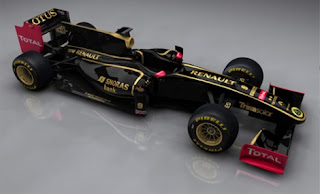
In the Formula One 2011 season there will be two teams with "Lotus" in the name - Lotus Renault GP and Team Lotus. However, one has a Renault engine, and the other has a Cosworth. There appears to be mass confusion already on the internet over the similarity of the team names, and it appears that a legal battle might not be far from ensuing between the two teams. Furthermore, there is talk that Team Lotus (who made their debut last year in the green and yellow colours) may change that paintjob to match that of the renamed Lotus Renault GP team (who, without the Lotus sponsorship, had a yellow and black colour scheme). The newly renamed team has decided to revert to a very familiar paint scheme and black and gold - paying tribute to the likes of Nigel Mansell and Aryton Senna:


Isn't that a thing of beauty? However, seeing four of these whiz 'round a circuit might be a bit of overkill. Time will tell. Robert Kubica still has no partner for next season after the departure of Vitali Petrov, but whoever gets an opportunity to drive in this piece of machinery is one lucky soul.

Friday, November 26, 2010

List: My Favourite Current F1 Racetracks

Again, I don't utilise this blog as much as I should. So here's a huge entry to make up for it.

Formula One, admittedly, is being turned into too much of a technicality at times. The behaviour of the modern formula one car can be a little predictable. The lack of two extra cyclinders has made the cars sound, and look, less exciting than a few years ago. However, the demanding style of racing still exists today, and there are still just as many reasons to enjoy Formula One racing. At the top of that list is the racetrack. Every racetrack is a new experience, some a little more demanding than others. Whether it be the swerving nature of Albert Park, the sheer elevation changes in the corners of Spa, the thrilling Spoon curve at Suzuka or the constant speed of Monza, every track requires a different style and a different strategy.

I didn't start following the Formula One series to a great extent until the post-Schumacher years, but although new champions rise up, the tracks keep their charm and individuality. Here is a top 10 of my favourite tracks that featured in the past couple of seasons. I'm not going to pretend that I know everything about the way a racetrack should be - remember I actually hardly know that much about the mechanics of racing itself, I just happen to have an opinion just like any other human being. Anyway, I hope you enjoy this special entry!

#10: Hungaroring
Favourite Corner: 6
The best part of the Hungaroring comes from turns 6 to 13. Before this section, the climb up the track includes a nice, downshifting turn (3) before making the climb into the swerving second sector. Turn 6 is the clear track highlight, a blind turn that challenges the driver to put his foot down as flat as he dares to. Beyond this turn comes a nice set of corners (8 through to 12) that hardly allow the driver to keep the steering wheel horizontal. Beyond this is a fairly routine run to the finish, with the final few corners providing nowhere near the challenges of the middle.

#9: Catalunya
Favourite Corners: 5, 9
This classic Spanish track, which is full of flow and very little stop/start corners, is full of fun. It has one of the most exciting starts of a track, with the driver always giving full, alternating turns of the wheel between the first three corners. The subtle elevation change in turn 5 demands careful driving, while the near-blind rise into Campsa (turn 9) is another definite track highlight. A slightly more technical 2nd half of the track provides a contrast to the sheer open curves of the first and second sectors. A simple, but full-throttle, final turn leads into one of F1's best straights.

#8: Nurburgring
Favourite Corner: 10
Out of the two German tracks that share rights to the Formula One round every season, the Nurburgring wins out over the redesigned Hockenheimring. The track comes out on top for a few reasons. The run from 8 to 10 is glorious. Drivers pick up the throttle early into 8 and make a great exit before flying through the Michael Schumacher Chicane with the foot down. A full speed turn 14 is another highlight. Although (in my opinion) this track is a step back in quality from the pure monster that is its older brother, the Nordschleife (Northern Loop), this track is full of great moments.

#7: Suzuka
Favourite Corner: 14
A true surprise package from Japan which includes the famous Spoon curve and 130R turn. The climb from turns 3 to 7 pulls some nice G forces, all while making a challenging ascent. Much of the elevation changes come from the circuit's unique figure-8 layout. It makes the track a track of two distinct halves, and I love that. 130R is a huge, downhill sweep that signals the run home to the finish. Taken at up to 310 km/h in the modern F1 car, it demands careful driving on the apex. Once that run is finished, a huge hit of the brakes marks the final chicane, and then the finish line. Start it all again.

#6: Istanbul
Favourite Turn: 8
I think I've even surprised myself by adding this to my list, but what can I say? It surprised me. Full turns, insane speeds and tons of elevation. It's everything you could want in a track. Turn 8 is the obvious attention-grabbing point of the track - a four-apex thriller. Turn 1 is a beautiful, downhill sweep to the left. It is, along with the first turn of Albert Park, one of my favourite opening corners in the series. The track has amazing flow compared to other tracks of the Middle East and Asia. And finally, how could I not include Istanbul with what is easily the most stunning pit complex in the competition?

#5: Silverstone
Favourite Corners: 3 & 4
This is a track that is full of history, and even with a redesign for this year's Grand prix, it still retains its brilliance. One of the greatest parts about the track is the ample opportunity for overtaking. Stowe (7) is one fine example, along with the new Abbey corner on the redesigned section. Maggotts and Becketts are a great set of corners with over 4G's of force that are the track highlight for me, and many other fans as well. The new Arena segment is challenging, but still with plenty of speed, and takes nothing away from the track. With a guaranteed stay in F1 until at least 2026, this historic circuit will provide many more years of great moments.

#4: Interlagos
Favourite Corners: 1 & 15
My goodness they used to know how to make racetracks back then. This track has phenomenal overtaking potential, most notably on the downhill stretch of the exciting Senna 'S' bend, through to the long, wide turn 3. The track is as bumpy as they come. The run home from turn 13 through to 15 is taken at breakneck pace while darting uphill. It's a joy to watch the cars struggle up the back stretch for such a lengthy amount of time, putting huge strains on their engines - in a similar fashion to Monza. This track is the jewel of Brazil.

#3: Monza
Favourite Corner: 8
The engine-killer. The gearbox-breaker. Drivers spend about 75-80% of the time with their foot to the floor on this Italian juggernaut. It's all about how well you can stop and get it going again. Consistently. The track is just 8 corners, the last of which (Curva Parabolica) is just a dab of the break and a huge acceleration to the right. It's another one of my favourite corners in racing. If carried out well it can provide a daring braking opportunity into turn 1. Even though there is little technical points in the track design, flat-out fun is what Monza dishes out and I never grow tired of it.

#2: Monaco
Favourite Corner: 9
Is it possible to like a track equally for it's technical aspects as much as the scenery and history that surrounds it? In fact, I think it may be necessary to do so. Amidst the gorgeous buildings, casinos and harbour lies the most claustrophobic track in the world. There is a reason winning this race is considered a lifetime achievement in itself - the next best thing to winning a championship. If I am forced to pick one particular point of interest, it is the tunnel on turn 9. You only have to watch a replay to see how difficult it is for drivers to adjust to the changing light conditions. The Grand Hotel hairpin (6) is now one of the most iconic images in F1 racing, if not, world racing. This tight, menacing piece of tarmac is probably worthy of being an equal #1 on my list, but here is the track in question.

#1: Spa-Francorchamps
Favourite Corners: 2-4 & 17
Probably the greatest racetrack in the world, as far as I see it. It has the greatest elevation change compared to all the others listed here - easily. Eau Rouge is the greatest segment of turns in the calendar. Drivers actually need to go faster than normal to keep enough downforce through the infamous down and up section, which explains the dizzying speeds seen as drivers go over the blind turn 4 exit. Once the pinnacle of the track is reached, at around turn 7, so begins the most dangerous set of turns you will see in racing. All of them downhill. All of them different variations. The pick of these turns are Pouhon at 12 and Blanchimont at 17. Pouhon hits drivers with almost 5G's of force, and is effictively a double-apex turn, instead of the separated 12 & 13. Blanchimont is raw power, and comparable to Suzuka's 130R in style. Except this time the elevation is more exaggerated. A simple paragraph cannot possibly sum up the joy of watching races on this track.

I hope you have enjoyed reading this list as much as I enjoyed making it. I look forward to seeing all these tracks returning next year, including the new Jaypee Group Circuit in India. A huge 20-round calendar awaits us next season.

Sunday, August 1, 2010

Happy Hunting in Hungary

Mark Webber has won the Hungarian Grand Prix in front of Fernando Alonso and teammate Sebastian Vettel.
The race provided far more action than the previous round in Germany last weekend, and the final result at Budapest has turned the championship standings on their head.
The first half of the race provided the baulk of the action, which all began on the starting grid.
Vettel led through the first turn while Webber slipped back behind a determined Alonso.
With some debris being littered across the track, a quick scramble for the pits was made.
Kubica and Sutil collected each other as the Renault lollipop operator made a critical mistake, leading to the premature exit of Kubica from his pit area.
The whole moment was chaotic enough, but was made to look even more astounding as a Rosberg right-rear wheel blasted down the pit lane directly above the scene of the accident.
It certainly goes down as one of the more surreal moments in the championship.
Meanwhile, out on the track, Webber had not pitted and was in first, but with a the entire field sitting behind him. His race looked to be over.
But during the safety car period, his teammate Vettel deliberately held up traffic, but ventured beyond the 10 car-length limit and incurred a drive through penalty.
Webber continued on, during the commotion, to move up almost a second a lap ahead of Alonso.
He needed a 20 second gap - on the soft tires - to be able to come out of the pits in first place.
After driving a string of blistering laps, he managed to achieve this, and wasn't bothered again til the end of the 70 laps.
The back end of the race was marred by a dangerous defensive manouvere by Michael Schumacher (10th) on Rubens Barrichello (11th) that nearly ended horribly.
Luckily, they managed to avoid an accident, with the Brazillian moved past Schumacher to take the remaining point on offer for the day.
Schumacher's move was very questionable. Barrichello later stated that it was the most dangerous move he had been on the end of in his career, adding that he was lucky the wall ended where it did.
With the 1-2-3-4 Red Bull & Ferrari finish, claims are still fresh about the possible presence of flexible front wings on the four cars, and possibly the McLaren team of Lewis Hamilton and Jenson Button as well.
You wouldn't have known after Hamilton ended up ditching his car on the side of the road and Button finishing a dissappointing 8th.
Webber's victory puts him on top of the standings on 161 points, ahead of Hamilton on 157. Vettel moves on to 151, leapfrogging Button who sits on 147.
A decision on the wing debate could be expected as early as tomorrow, but should be no later than the end of this week.
In the meantime, Webber has the next four weeks at least to himself on top of the ladder.

Sunday, July 25, 2010

Racing Politics at Play in German Grand Prix

Ferrari have taken first and second at the German Grand Prix in the Formula One Championship.
Fernando Alonso took the checkered flag ahead of teammate Felippe Massa with pole-sitter Sebastian Vettel filling the final podium position at his home race.
It was the 19th victory for Ferrari at the Hockenheimring, and the second for Alonso after his win in the opening round at Bahrain.
Vettel did not nail his start, once again, and the two Ferraris passed immediately.
Despite his efforts to pin Alonso to the wall, Vettel tumbled back two spots, as Massa passed both drivers during the scrap.
Championship leader Lewis Hamilton finished fourth and Mark Webber finished fifth, managing to take control back of his car after some oversteer issues in the middle of the race.
But Alonso's win wasn't without controversy.
At the 49th lap of 67, Massa was leading the race and held a buffer of several seconds over his teammate.
Then he suddenly allowed Alonso to pass after the hairpin.
After an initial state of confusion by commentators and viewers, the in car replay of Massa confirmed he was not applying full throttle.
It confirms the prescence of racing politics in the lucrative event.
Teams seek championship winners and do not promote the idea of the best day's performer winning, but the best year's performer.
They don't care about the present, but only the future.
It angers fans and takes the skillful touch away from the event.
It wasn't hard to see that Massa was hurt by the decision, which he obviously had no say in.
He struggled to keep Alonso's wheel after the pass, and was slowly being approach by Vettel from behind.
His indifferent greeting to Alonso after the race also demonstrated this - not even giving his teammate any eye contact. Massa knew he was the better man out there.
He made his feelings known in the press conference afterwards, without having to say too much.
Massa stated that he did feel he was the better driver, and did very little to hide it.
"It's a very strong result for the team" stated Alonso, who avoided much talk of his individual effort, most certainly out of guilt.
It now adds fire to the issue of driver hierarchy within teams, after the well-publicised scrap within the Red-Bull Racing team between Mark Webber and Vettel.
After winning the Silverstone GP, Webber announced over the radio that his effort was "not bad for a number two driver."
The Red Bull debacle was sparked when a new front-wing on Webber's car was moved onto Vettel's car for qualifying.
The team got the intended result with Vettel finishing on pole, but then Webber won the race.
The team made a tactical decision to switch car parts, but all they ended up with was bitterness between the halves of the team.
Although the best driver won in that case, these tactics are becoming dangerous to the competitive future of the sport.
Young drivers of the next generation must fear the competition for its severe favouritism for money over the respect and future prospects.
What kind of racing 'spectacle' are the Formula One teams providing when the best driver doesnt win?